

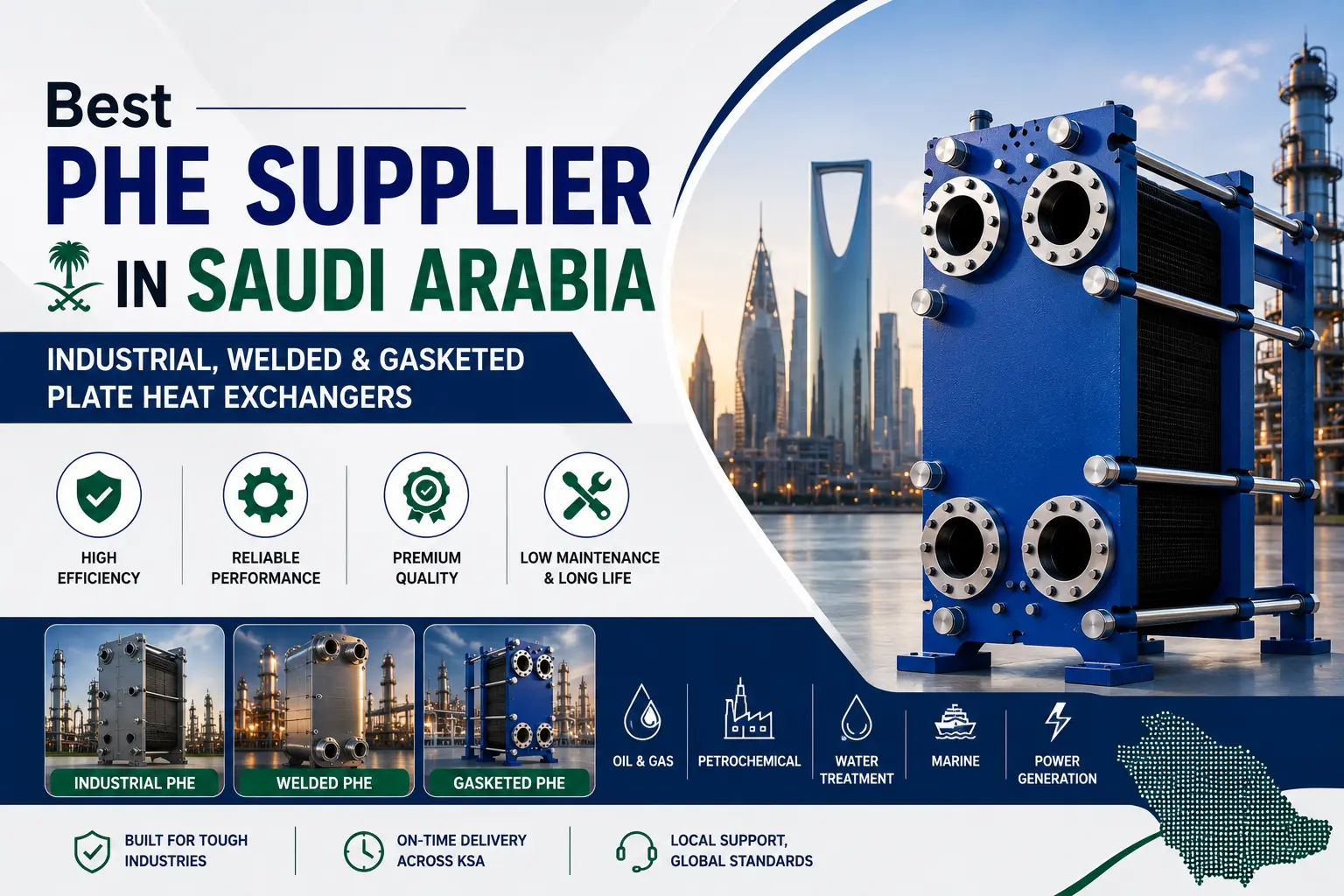
If you are responsible for plant operations, procurement, or maintenance in Saudi Arabia, you know the challenge. Your facility runs in extreme heat. The cooling water is often challenging. Production targets are aggressive. And the last thing you need is a plate heat exchanger that fails mid-shift.
Saudi Arabia is undergoing an unprecedented industrial transformation. Under Vision 2030, the Kingdom is building new factories, expanding petrochemical complexes, and modernizing power and water desalination plants. The industrial sector has grown from 7,200 factories before Vision 2030 to over 12,500 facilities by mid-2025, with industrial investment climbing from SR955 billion to SR1.2 trillion. The non-oil economy is forecast to grow 4.3% in 2025, supported by strong domestic demand. Every new plant needs reliable thermal management. That means plate heat exchangers.
SRJ India serves industrial buyers across Saudi Arabia. We are a manufacturer, not a trader. We supply industrial plate heat exchangers in Saudi Arabia for refineries, chemical plants, power stations, desalination facilities, HVAC systems, and food processing units. This article explains what we offer, how to choose the right type, and why buying directly from a manufacturer makes business sense.
Why Saudi Arabia Needs High-Quality Plate Heat Exchangers
Saudi Arabia is not just an oil economy anymore. The National Industrial Strategy aims to triple manufacturing’s GDP contribution to $238 billion by 2030. The Kingdom is advancing 12 key industries, including petrochemicals, mining, renewable energy, pharmaceuticals, and advanced manufacturing. More than 1,200 new factories began operations in 2025, attracting over SR31 billion in investments and creating more than 45,000 jobs.
This industrial boom drives massive demand for heat transfer equipment. The Saudi Arabia heat exchanger market generated revenue of USD 433.5 million in 2025 and is expected to reach USD 759.4 million by 2033, growing at a CAGR of 7.6%. The plate and frame heat exchanger segment alone was valued at USD 156.5 million in 2025 and is projected to reach USD 282.6 million by 2033.
But market growth alone does not guarantee quality. Many suppliers in the region offer standard units that are not designed for Saudi conditions. High ambient temperatures, aggressive cooling water chemistry, and continuous operation put immense stress on gaskets, plates, and welds. A heat exchanger that works fine in a temperate climate may fail within months in Jubail or Yanbu.
SRJ designs and manufactures plate heat exchangers that handle demanding conditions. We supply welded plate heat exchangers in Saudi Arabia for high-pressure and high-temperature applications. We supply gasketed plate heat exchangers in Saudi Arabia for general industrial duties. And we supply industrial plate heat exchangers in Saudi Arabia for every major sector – petrochemical, power, desalination, HVAC, and food processing.
Types of Plate Heat Exchangers for Saudi Industries
Based on SRJ’s engineering capabilities, here are the main types of plate heat exchangers available for Saudi buyers. Each type is suited for specific applications.
Gasketed Plate Heat Exchanger in Saudi Arabia
Gasketed plate heat exchangers are the most common type used across Saudi industries. They consist of corrugated metal plates fitted with elastomeric gaskets. The gaskets seal the channels and direct fluids into alternate passages. This design allows easy disassembly for cleaning, inspection, and plate replacement.
In Saudi Arabia, gasketed plate heat exchangers are used for HVAC chilled water systems in commercial buildings and hotels in Riyadh, Jeddah, and Dammam. They are used for process heating and cooling in petrochemical plants. They are used for heat recovery in power generation facilities. And they are used for cooling lubricating oil in industrial machinery.
The gasketed plate heat exchanger segment led the Saudi market with the largest revenue share of 52.0% in 2024. This dominance reflects the versatility and cost-effectiveness of gasketed designs for clean fluid applications.
However, gasketed units have limitations. They are not suitable for high pressures above 15 bar or high temperatures above 180 degrees Celsius. Gaskets can degrade over time, especially when exposed to aggressive chemicals or高温. For such conditions, you need welded designs.
Welded Plate Heat Exchanger in Saudi Arabia
A welded plate heat exchanger has the plates welded together instead of sealed with gaskets. This eliminates the risk of gasket failure and leakage. Welded units handle higher pressures and temperatures, making them ideal for demanding applications.
In Saudi Arabia, welded plate heat exchangers are used in refineries for hydrocarbon processing. They are used in petrochemical plants for handling aggressive solvents. They are used in power plants for high-pressure feedwater heating. They are also used in desalination facilities where seawater corrosion and high pressures are concerns.
Fully welded plate heat exchangers can handle temperatures up to 400 degrees Celsius and pressures up to 40 bar or higher. There are no gaskets to replace, no permeation risks, and no chemical attack on elastomers. For Saudi plants running continuous operations, welded units offer lower long-term maintenance costs.
SRJ also offers semi-welded plate heat exchangers, which combine welded channels on one side and gasketed channels on the other. This hybrid design is ideal when one fluid is aggressive or hazardous but the other is clean. The welded side eliminates leakage risk for the aggressive fluid, while the gasketed side allows easy maintenance for the clean fluid.
Industrial Plate Heat Exchanger in Saudi Arabia
Industrial plate heat exchangers cover a broad category including brazed, semi-welded, fully welded, and wide gap designs. They are built for heavy-duty continuous operation in demanding environments.
For Saudi Arabia’s industrial sector, SRJ supplies:
Brazed Plate Heat Exchangers – Compact, no gaskets, ideal for HVAC, refrigeration, and hydraulic oil cooling. The brazed plate heat exchanger market in Saudi Arabia is valued at USD 65 million, driven by demand for energy-efficient cooling solutions across HVAC, oil and gas, and food processing.
Spiral Heat Exchangers – Self-cleaning design with a single-channel construction. Ideal for sludges, slurries, wastewater, high-viscosity liquids, and fluids containing fibers or solids. The spiral coil itself contributes to turbulent flow, and accumulated deposits create local velocity increases that produce a scrubbing effect to loosen fouling. Hinged covers with C-clamps allow easy access without special tools.
Wide Gap Plate Heat Exchangers – Designed for fibrous fluids and fluids containing coarse particles. Configured with wide-wide or wide-narrow channels. Smooth port design prevents fibers from snagging at the entrance. Essential for sugar distilleries, bioethanol plants, pulp and paper, and condensers for heat recovery.
Which Saudi Industries Need Plate Heat Exchangers
Petrochemical and Refining
Saudi Arabia is a global petrochemical powerhouse. Major complexes in Jubail, Yanbu, and Rabigh operate 24×7. These facilities need semi-welded and fully welded plate heat exchangers for handling aggressive hydrocarbons, acids, and high-temperature streams. Standard gasketed units are not suitable for many of these services due to chemical incompatibility and high pressures.
Power Generation
Saudi Arabia is adding multiple gigawatts of renewable electricity each year, while also modernizing thermal power plants. Combined cycle power plants use plate heat exchangers for heat recovery, condenser cooling, and lube oil cooling. Desalination plants paired with power facilities use plate heat exchangers for brine heating and cooling.
Desalination
Water security is a national priority. Large desalination plants along the Gulf coast use plate heat exchangers for preheating seawater, cooling distillate, and heat recovery. Seawater is highly corrosive, requiring titanium or super duplex stainless steel plates. SRJ supplies plate heat exchangers in high-alloy materials for desalination applications.
HVAC and District Cooling
Saudi cities are expanding rapidly. Riyadh, Jeddah, Dammam, and the new megaprojects like NEOM and Red Sea Global require massive district cooling capacity. Gasketed and brazed plate heat exchangers are the backbone of these systems, transferring chilled water from central plants to buildings.
Food and Beverage
Saudi Arabia aims to develop over 800 new food factories by 2035. Food processing requires hygienic plate heat exchangers for pasteurization, UHT treatment, and cooling of juices, dairy, and sauces. Gasketed units with EPDM or Viton gaskets are standard. Wide gap units handle viscous products like ketchup and fruit purees.
Pharmaceuticals and Advanced Manufacturing
The advanced manufacturing sector in Saudi Arabia is growing rapidly. Pharmaceutical plants require clean, gasket-free brazed or fully welded plate heat exchangers for purified water systems and solvent recovery. The Advanced Manufacturing and Production Center, launched in 2025, is accelerating industrial transformation through adoption of advanced technologies.
How to Choose the Right PHE Supplier in Saudi Arabia
You have many options for plate heat exchanger suppliers in Saudi Arabia. Global brands like GEA, SWEP, and Danfoss have a presence. Local manufacturers and traders also offer products. Here is what you should evaluate before making a decision.
Manufacturing Capability
Does the supplier actually manufacture the plates, or do they just assemble imported components? A genuine plate heat exchanger manufacturer controls plate pressing, welding, gasket molding, and pressure testing. This ensures consistent quality and faster customisation. SRJ is a manufacturer, not a trader.
Material Options
Saudi applications often require high-alloy materials. Stainless steel 304 and 316 are standard for clean water. For seawater, you need titanium or super duplex. For sulfuric acid, you need Hastelloy or SMO 254. Ask your supplier what materials they can offer. SRJ provides full material certification.
Gasket Quality
Gaskets are the most common failure point in plate heat exchangers. In Saudi Arabia’s heat, gaskets age faster. EPDM is suitable for water and dilute acids. NBR is for oils. Viton is for aggressive chemicals. PTFE-coated gaskets offer the best chemical resistance. SRJ supplies genuine gaskets with material test certificates. Never mix gaskets from different manufacturers.
Service and Spare Parts Availability
When a gasket fails or a plate is damaged, you need replacements quickly. A supplier without local stock or a responsive supply chain will leave you waiting for weeks. SRJ maintains buffer stock of plates and gaskets for all current models. For urgent requirements, express shipping to Saudi Arabia is available.
Welded vs Gasketed
If your application involves high pressure, high temperature, or aggressive fluids, choose welded or semi-welded. If both fluids are clean and pressures are moderate, gasketed units are more economical. SRJ can advise you based on your specific operating conditions.
Technical Comparison – SRJ vs Other Suppliers
SRJ India: Manufacturer-direct pricing. Offers gasketed, semi-welded, fully welded, spiral, wide gap, and brazed. ISO 9000 certified. Hinged covers on spiral units. Stock of spare plates and gaskets. Engineering support for thermal design.
Global Brands (GEA, SWEP, Danfoss): Strong brand recognition. Wide product range. Typically sell through distributors, not directly. Higher prices due to brand premium and distribution margins. Spare parts are available but costly.
Local Traders and Assemblers in Saudi Arabia: Lower upfront prices. Limited product range – usually only standard gasketed units. No semi-welded, spiral, or wide gap. Often no ISO certification. No stock of spares for older models. Limited technical support.
For Saudi buyers looking for a reliable PHE supplier in Saudi Arabia, SRJ offers the best balance of quality, pricing, and support. We are not the cheapest, but we are the most reliable for demanding applications.
Frequently Asked Questions
Question 1 – Does SRJ have a branch office in Saudi Arabia?
SRJ primarily operates from our manufacturing facility in India. However, we ship directly to Saudi ports and work with logistics partners for door delivery to Jubail, Yanbu, Dammam, Riyadh, Jeddah, and other industrial cities. For urgent spare parts, we can arrange express shipping.
Question 2 – What is the typical lead time for delivery to Saudi Arabia?
Standard gasketed and brazed units: 10 to 15 working days from order confirmation. Semi-welded, spiral, and fully welded units: 25 to 30 working days. Express delivery is available for emergency replacements at additional cost.
Question 3 – Do you provide installation and commissioning support in Saudi Arabia?
For larger projects and complex applications, SRJ can send a service engineer to Saudi Arabia. For smaller units, we provide detailed manuals and video support. Many Saudi customers have successfully commissioned units themselves using our documentation.
Question 4 – What gasket materials do you recommend for Saudi conditions?
For HVAC and water applications: EPDM. For hydraulic oil cooling: NBR. For aggressive chemicals: Viton or PTFE-coated. For high-temperature applications above 150 degrees Celsius: consider welded units instead of gasketed.
Question 5 – Can you supply plate heat exchangers for seawater cooling in desalination plants?
Yes. SRJ supplies plate heat exchangers with titanium, super duplex, and other high-alloy materials suitable for seawater service. We also offer fully welded units to eliminate gasket corrosion risks.
Question 6 – How do I get a quote for my Saudi plant?
Contact SRJ with your application details – fluid types, flow rates, temperatures, pressures, and materials compatibility. Our engineers will perform a thermal design and provide a manufacturer-direct quote.
Conclusion – Your Trusted PHE Supplier in Saudi Arabia
Whether you need a gasketed plate heat exchanger for a district cooling plant in Riyadh, a welded plate heat exchanger for a petrochemical complex in Jubail, or an industrial plate heat exchanger for a desalination facility in Yanbu, SRJ India delivers.
Saudi Arabia’s industrial future is bright. The number of factories has nearly doubled under Vision 2030. Non-oil exports reached record levels in 2025. And the demand for efficient, reliable heat transfer equipment will only grow.
SRJ is ready to support that growth. We are a manufacturer, not a middleman. We offer competitive pricing, genuine quality, and responsive support. Describe your application, and we will provide the right solution.