
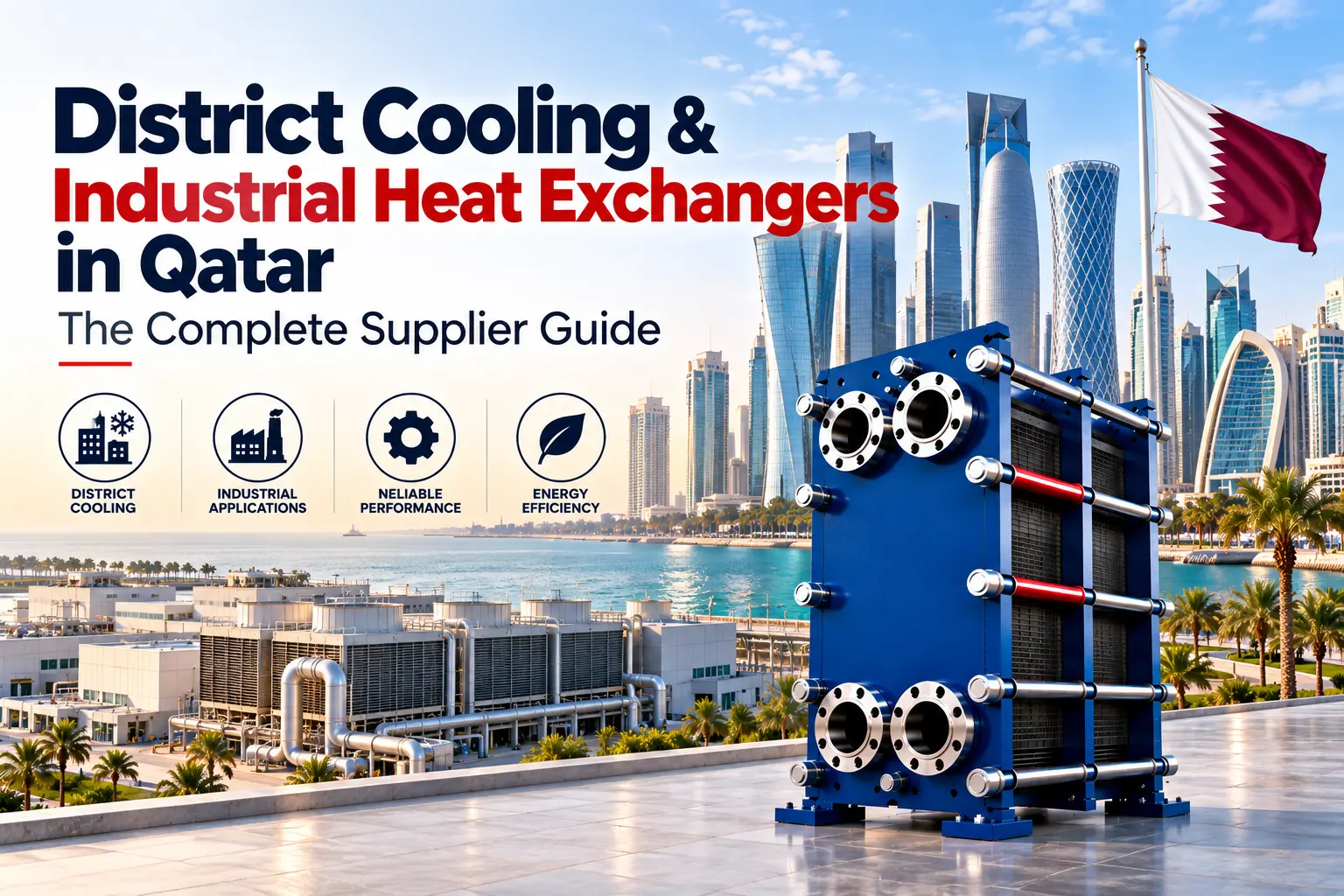

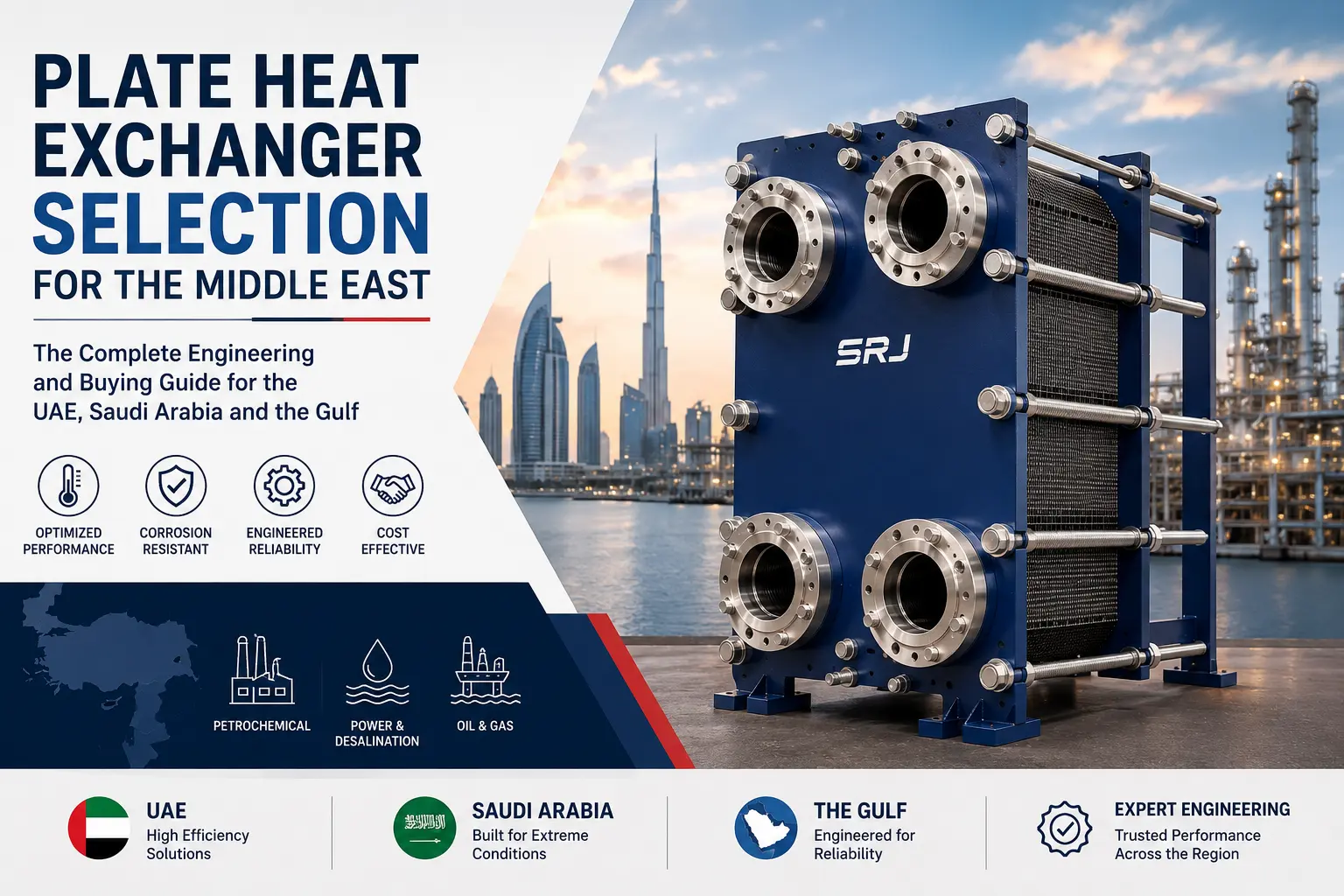
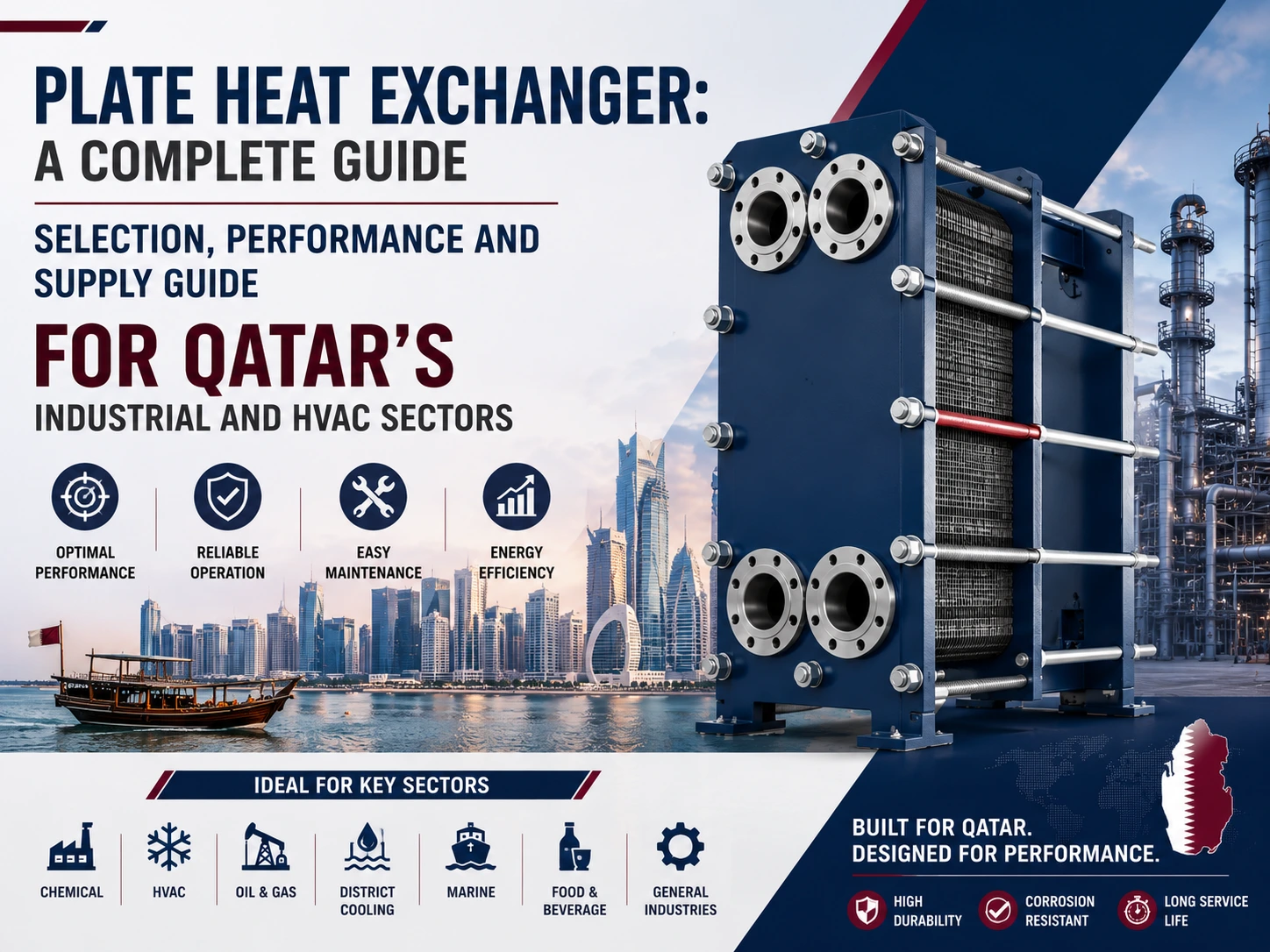
A plate heat exchanger transfers thermal energy between two fluids across a stack of thin, corrugated metal plates without letting them mix. In Qatar, where ambient temperatures regularly cross 45°C and cooling loads run almost year-round, this compact technology anchors district cooling networks, HVAC chilled-water loops, and process cooling across the oil, gas and desalination sectors. This guide covers how PHEs work, where they’re used across Qatar’s industrial landscape, how to select and maintain one, and what actually drives cost and reliability over a multi-year service life.
What Is a Plate Heat Exchanger and How Does It Work?
Direct answer: A plate heat exchanger (PHE) uses pressed metal plates, separated by gaskets or brazed/welded joints, to create alternating channels for hot and cold fluids. Heat passes through the thin plate walls while the fluids stay separated. The corrugated plates create turbulent flow at low velocities, which is why PHEs achieve far higher heat transfer coefficients per square metre than shell-and-tube designs of comparable size.
Plates, Gaskets, Frames and the Three Main PHE Types
Every gasketed unit has a fixed frame plate, a movable pressure plate, tightening bolts, and a plate pack compressed between them. The chevron angle stamped into each plate governs pressure drop and turbulence, so fouling-prone fluids often call for a wider angle to cut clogging risk. Gasketed PHEs open for inspection and plate replacement, making them the default for HVAC and district cooling duties needing periodic cleaning. Brazed units are compact and sealed but can’t be mechanically cleaned, while welded or semi-welded units handle higher pressures and harsher chemicals at the cost of serviceability.
Why Plate Heat Exchangers Matter for District Cooling in Qatar
Qatar has built one of the region’s most extensive district cooling networks, serving developments such as The Pearl, Msheireb Downtown, West Bay and Lusail. At the entry point of nearly every connected building sits an Energy Transfer Station, and a district cooling heat exchanger in Qatar installation is almost always a plate-and-frame unit at that interface.
The Role of PHEs in Energy Transfer Stations
The heat exchanger keeps the district network’s chilled water circuit hydraulically separate from the building’s internal circuit while still transferring the cooling effect between them. This protects the district operator’s water quality and pressure regime, and lets each building’s system be serviced independently without draining the network. A single ETS-grade PHE in a mid-rise tower might run continuously for 15–20 years if the plates and gaskets suit the water chemistry involved. As new districts add cooling capacity, demand for correctly sized PHEs grows alongside retrofit work on aging ETS units, and engineers increasingly favor suppliers, such as SRJ Heatt Exchangers India Pvt. Ltd., who understand both thermal design and Gulf water chemistry, where higher total dissolved solids and chloride content accelerate corrosion in poorly specified plate materials.
HVAC Plate Heat Exchanger Applications in Qatar’s Climate
Beyond district cooling, a HVAC plate heat exchanger in Qatar setting typically appears in chilled water plant rooms, condenser water loops and heat recovery ventilation systems in large commercial and hospitality buildings.
Chilled Water Systems and Free Cooling
PHEs isolate primary and secondary chilled water loops in large HVAC plants, letting chillers operate against a stable, protected circuit while the secondary side serves fan coil and air handling units. In facilities with process cooling towers, a plate heat exchanger can also enable partial free cooling during Qatar’s cooler winter months, cutting compressor run hours when wet-bulb conditions allow it. High ambient temperatures push condenser loops toward higher operating temperatures, raising scaling risk if make-up water isn’t properly treated, so a unit with too tight a temperature approach leaves little thermal margin once fouling begins.
Industrial Heat Exchanger Applications Beyond HVAC
Qatar’s economy is anchored by LNG production, gas processing, power generation and desalination, and each sector relies on heat exchange equipment far beyond comfort cooling. An industrial heat exchanger in Qatar context usually means higher pressures, harsher fluids and stricter compliance than a typical HVAC installation.
Oil, Gas, LNG, Power and Desalination
Process plants use PHEs and their welded variants for interstage cooling, glycol regeneration support and utility water heat recovery, where compactness matters in constrained layouts. Ras Laffan Industrial City, home to much of Qatar’s LNG and gas-to-liquids capacity, is a concentrated cluster of this demand, alongside sustained maintenance and overhaul work on existing units. Power and desalination plants similarly rely on heat exchangers for cooling water, lube oil cooling and process heat recovery — and since desalination output ties directly to equipment uptime, unplanned PHE failures carry consequences beyond one plant’s maintenance budget.
How to Choose the Right Plate Heat Exchanger
Selection is a sequence of trade-offs between thermal performance, material compatibility and maintenance cost — not a single decision.
Plate Material Selection: 304, 316 or Titanium
Stainless steel 316/316L is the standard choice for most water-based HVAC and district cooling duties because of its chloride resistance relative to 304. Titanium becomes necessary where chloride concentrations are higher, such as seawater-cooled condensers or coastal loops, because it resists pitting corrosion far longer under those conditions. Choosing 316 where titanium is genuinely required is one of the most common and expensive specification mistakes, since chloride stress corrosion cracking often surfaces only after a year or two of service.
Gaskets, Sizing and Getting Installation Right
NBR and EPDM gaskets cover most standard water and mild chemical duties, while Viton and PTFE-based gaskets handle higher temperatures and harsher media; compatibility must be checked against both the fluid and the plate material, since galvanic mismatches can accelerate corrosion at the seal line. A correctly sized PHE balances heat transfer area against pressure drop — oversizing wastes capital, undersizing leaves no thermal margin as plates foul. At installation, improper bolt torque is a frequent cause of early leakage, since plates need compressing to the specified pack dimension, and skipping a baseline pressure-drop reading at commissioning removes the reference point needed to catch fouling early.
Maintenance, Fouling and Troubleshooting
Recognizing Fouling Before It Becomes a Failure
A rising pressure drop at a steady flow rate usually points to particulate or biological fouling narrowing the channel passages. A widening temperature approach — where the unit no longer reaches its design outlet temperature — more often indicates scale or an organic deposit reducing heat transfer. Matching the cleaning method to the fouling type saves downtime and unnecessary chemical exposure.
Cleaning-in-Place vs Manual Disassembly, and Reading the Symptoms
CIP systems work well for routine fouling if they can achieve the manufacturer’s specified cleaning flow rate — often overlooked when CIP loops are designed around normal process flow rather than the higher rates cleaning actually requires. Manual disassembly remains necessary periodically, particularly where gasket condition and plate corrosion need visual confirmation. External leakage at the gasket line typically traces to gasket age or incorrect compression; internal leakage between circuits usually means a plate has developed a pinhole and needs replacement rather than a gasket fix; and reduced performance without a pressure-drop increase often points to flow maldistribution rather than fouling at all.
Cost Factors: What Actually Drives Plate Heat Exchanger Pricing in Qatar
Plate material and count are the largest cost drivers — titanium plates run well above 316 stainless, and every added plate adds material and gasket cost. Frame size and connection type matter too, since larger connections and higher pressure ratings push frame costs up. In Qatar specifically, freight, import duties and local spare-parts availability affect total cost of ownership as much as the purchase price — a unit cheaper upfront but needing spares shipped from outside the region can cost more over a five-year maintenance cycle once downtime is factored in.
Choosing a Plate Heat Exchanger Supplier in Qatar
Selecting a plate heat exchanger supplier in Qatar is as much about engineering support and spare-parts continuity as the initial quotation. A supplier who validates thermal design against actual site water analysis, rather than a generic catalogue selection, delivers units that perform closer to design specification over their full service life.
What to Look for in a Manufacturer or Supplier
Look for documented thermal design calculations, not just a datasheet; clarity on plate and gasket compatibility with your water chemistry; and confirmed lead times for replacement plates, since a unit that can’t be serviced quickly becomes a liability during peak cooling season. SRJ Heatt Exchangers India Pvt. Ltd. has supplied gasketed and semi-welded plate heat exchangers for HVAC, district cooling and process applications across the GCC, and the recurring lesson is simple: units that run smoothly for a decade are the ones where material selection and sizing were validated against real site conditions before manufacturing began, not adjusted afterward. Reviewing water analysis and stocking commonly needed spare plates is what separates a reliable supply relationship from a one-time transaction.
Frequently Asked Questions
What is a plate heat exchanger used for? A plate heat exchanger transfers heat between two fluids without mixing them, and is used in HVAC chilled water systems, district cooling energy transfer stations, industrial process cooling, and power and desalination plant utility systems.
How does a plate heat exchanger differ from a shell-and-tube exchanger? A plate heat exchanger uses stacked corrugated plates to achieve high heat transfer in a compact footprint, while a shell-and-tube exchanger uses bundled tubes inside a shell. PHEs generally offer higher efficiency per unit of space and are easier to expand by adding plates, but shell-and-tube units handle higher pressures and larger particulate loads more easily.
Which is better for district cooling — gasketed or welded plate heat exchangers? Gasketed units are generally preferred for district cooling energy transfer stations because they can be opened for periodic cleaning and inspection, which is important given the continuous operation and variable water quality typical of these systems.
How much does a plate heat exchanger cost in Qatar? Cost depends on plate material, plate count, frame size, pressure rating, and connection size. Titanium units cost considerably more than 316 stainless steel units of the same capacity, and total cost of ownership should also account for spare parts availability and expected maintenance frequency.
How often should a plate heat exchanger be cleaned? Cleaning frequency depends on water quality and fouling rate rather than a fixed calendar interval. Monitoring pressure drop and temperature approach against commissioning baseline values is the most reliable way to determine when cleaning is actually needed.
What causes a plate heat exchanger to leak? External leaks usually stem from gasket age, incorrect plate pack compression, or chemical incompatibility between the gasket and process fluid. Internal leaks between circuits typically indicate plate corrosion or erosion requiring plate replacement.
When should titanium plates be used instead of stainless steel? Titanium is recommended when chloride concentrations are high enough to risk pitting or stress corrosion cracking in stainless steel, such as seawater-cooled systems or certain coastal cooling loops common in Gulf installations.
How do I choose the right plate heat exchanger supplier? Prioritize suppliers who provide documented thermal design calculations based on your actual site conditions, confirm plate and gasket material compatibility with your fluid chemistry, and can supply replacement plates and gaskets within a reasonable lead time.
Can a plate heat exchanger be repaired instead of replaced? In most cases, yes. Gasketed units can have individual damaged plates replaced and gaskets renewed without replacing the entire unit, which is one of their key advantages over sealed brazed units for long-term industrial and HVAC service.
What affects plate heat exchanger performance over time? Fouling from scale, particulates or biological growth is the primary factor, followed by gasket degradation, flow maldistribution across the plate pack, and, less commonly, plate material corrosion from an incompatible fluid chemistry.
Conclusion
A plate heat exchanger performs a deceptively simple job — moving heat between two fluids — but getting that job right in Qatar’s climate and industrial mix depends on decisions made long before installation: plate material matched to actual water chemistry, gasket selection matched to the process fluid, and sizing that leaves genuine thermal margin rather than the tightest approach temperature on paper. Whether the application is an HVAC chilled water loop, a district cooling energy transfer station, or process cooling on an LNG or desalination line, the same principle holds: a plate heat exchanger specified against real site conditions, and supported by a supplier who can service it over its full working life, is the one that keeps running quietly for fifteen or twenty years instead of becoming a recurring maintenance line item.