
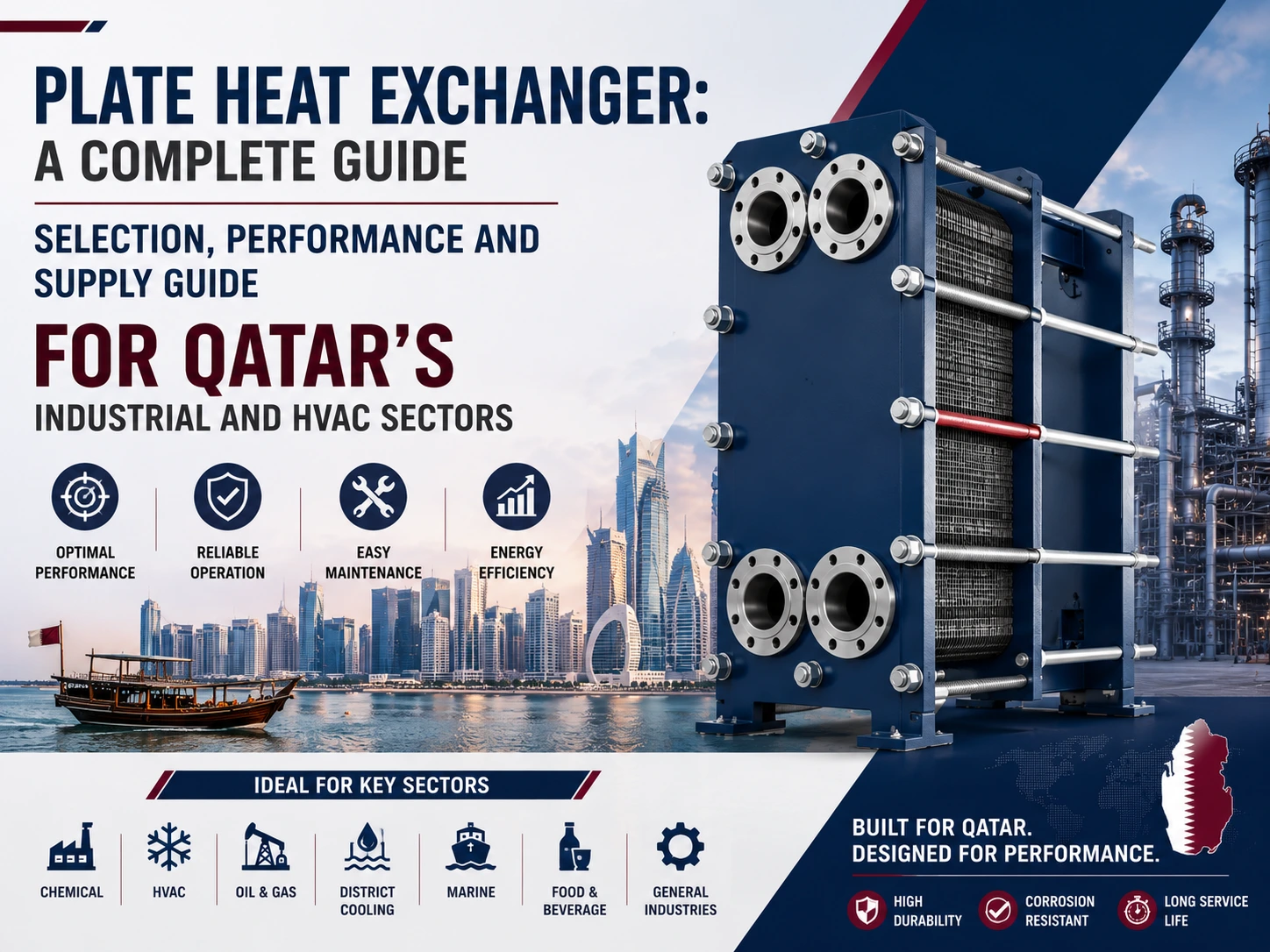

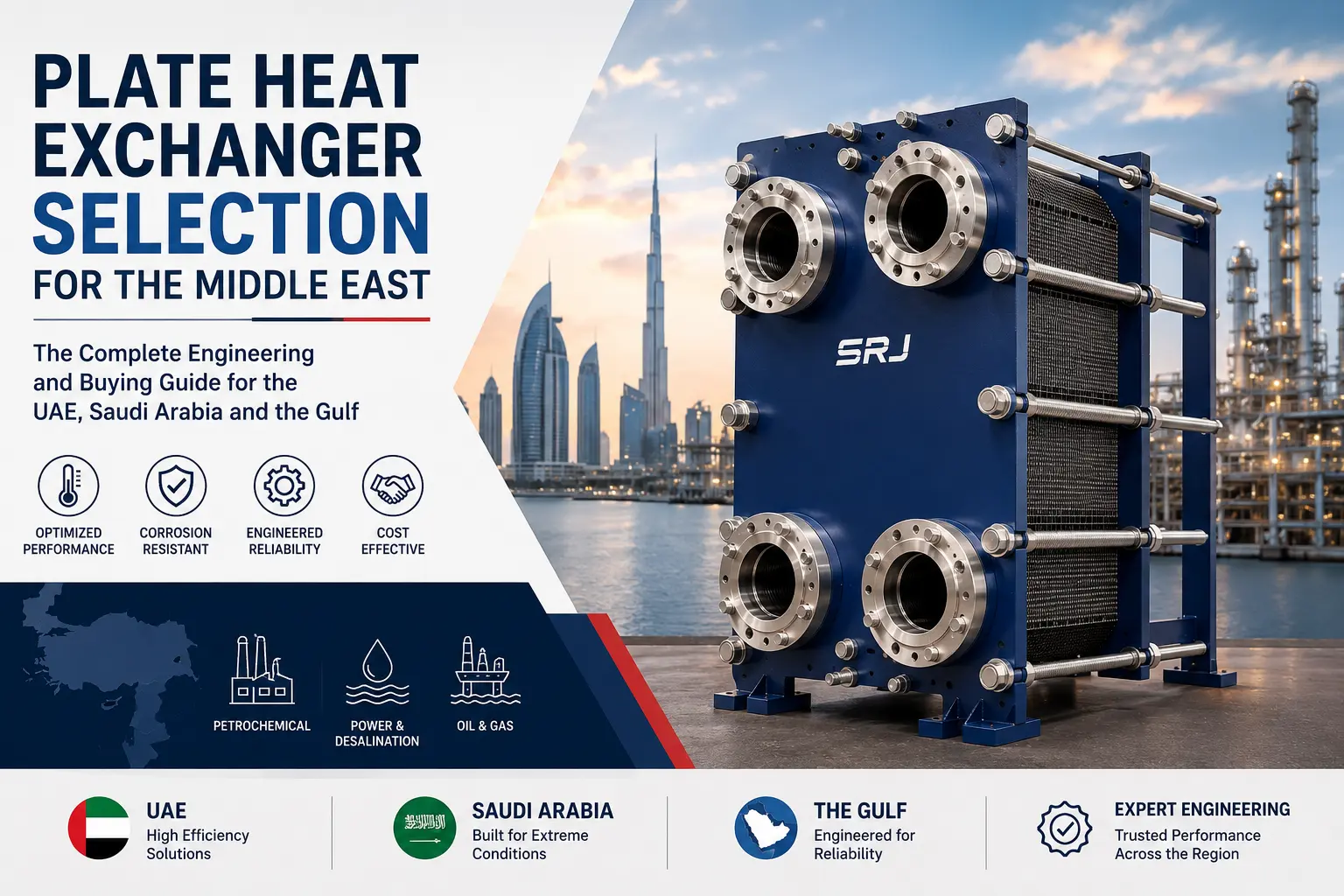
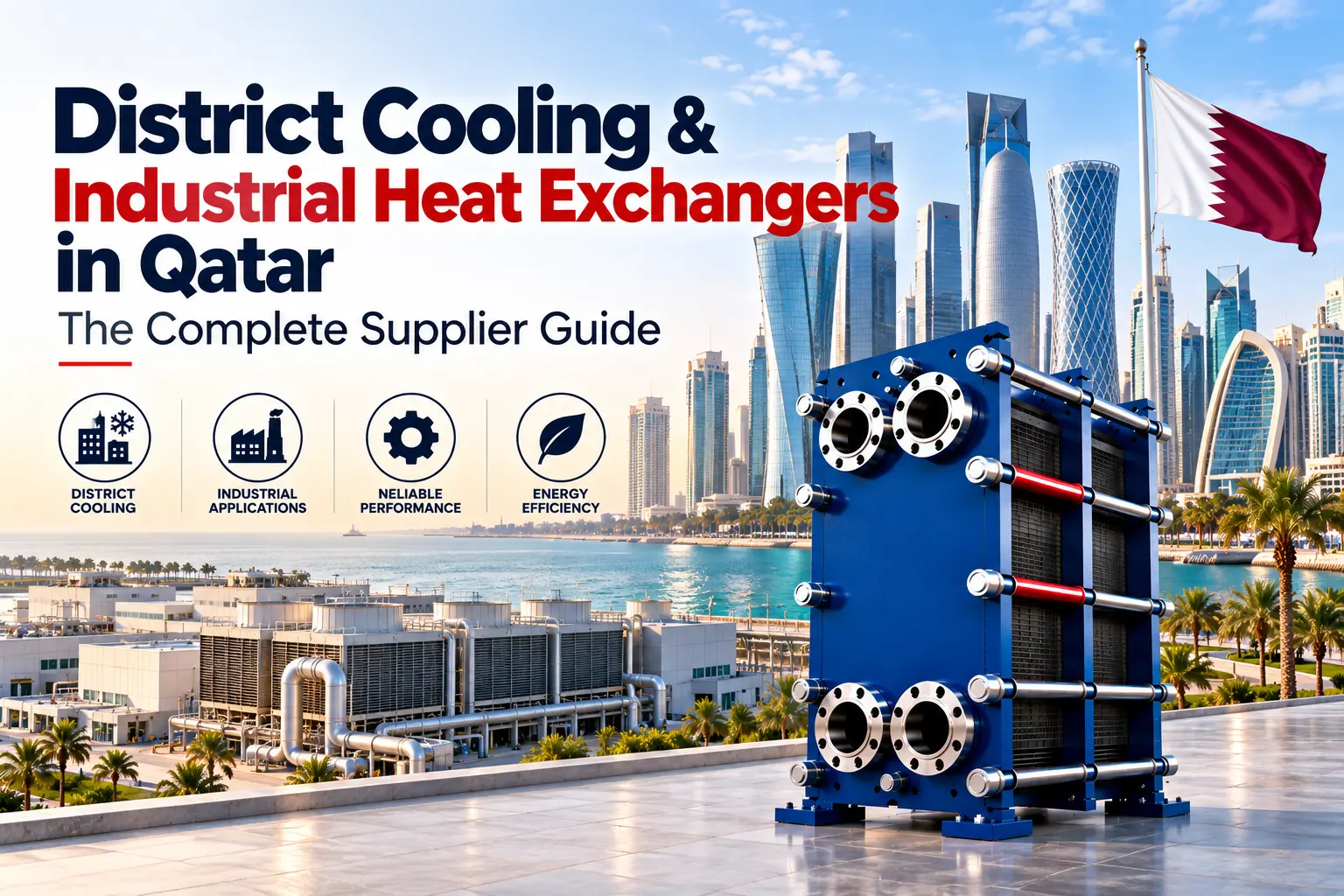
Heat exchangers in Qatar sit at the heart of two things the country’s economy quietly depends on — keeping its cities cool and keeping its heavy industries running. Qatar’s rapid transformation into one of the Gulf’s most modern economies has been built on two things that quietly depend on heat transfer: keeping its cities cool and keeping its industries running.
Behind almost every mall, stadium, high-rise, LNG train, and desalination plant in the country sits a heat exchanger doing critical thermal work.
Whether you are specifying a district cooling heat exchanger in Qatar for a new development in Lusail, or sourcing a rugged industrial heat exchanger in Qatar for a petrochemical or power plant, choosing the right equipment — and the right supplier — directly affects your project cost, reliability, and long-term maintenance burden.
This guide is written for consultants, MEP contractors, EPC firms, facility managers, and plant operators across Doha, Lusail, Al Rayyan, Mesaieed, Ras Laffan, and the wider country.
It covers how district cooling and industrial heat exchangers are used in Qatar, how to select the correct type and materials for the local climate, and why partnering with SRJ Heatt Exchangers — a specialist manufacturer of plate heat exchangers in Qatar and compatible spare parts serving the Middle East — gives you competitive pricing, fast lead times, and genuine engineering support.
Why Heat Exchangers Are Critical Infrastructure in Qatar
Qatar’s climate and economy place unusually heavy demands on thermal equipment. Summer ambient temperatures regularly exceed 45°C, cooling is a year-round necessity rather than a seasonal one, and the country’s hydrocarbon and utility industries operate continuously with very low tolerance for downtime.
Add to this the widespread use of seawater for cooling and the aggressive, high-chloride environment of the Gulf coast, and it becomes clear why robust, corrosion-resistant heat exchangers in Qatar are essential — not optional — infrastructure.
Two broad categories dominate the market. District cooling heat exchangers in Qatar serve the enormous demand for centralised air conditioning across Qatar’s cities and mega-developments. Industrial heat exchangers in Qatar serve oil and gas, petrochemicals, power generation, desalination, and manufacturing. Both categories increasingly favour plate heat exchangers in Qatar (PHEs) for their compactness, high efficiency, and serviceability — and both create an ongoing need for replacement plates, gaskets, and servicing over the equipment’s life.
District Cooling Heat Exchangers in Qatar
District cooling is one of Qatar’s signature infrastructure achievements. Instead of every building running its own chillers, a central cooling plant produces chilled water and distributes it through insulated pipe networks to many buildings across a district. This model is far more energy-efficient, saves space, reduces maintenance, and lowers the urban heat footprint — all critical advantages in Qatar’s climate.
Major developments such as Lusail City, The Pearl, Msheireb, and stadium and metro precincts rely heavily on district cooling networks.
Where the heat exchanger fits in a district cooling system
At the heart of every building connection in a district cooling scheme sits a plate heat exchanger. It hydraulically separates the primary chilled-water loop (owned by the district cooling operator) from the secondary loop (inside the building), while transferring the cooling energy between them. This separation is essential: it protects the primary network from building-side pressure and water quality, allows accurate energy metering, and lets each building operate independently.
Because these units run continuously through Qatar’s long, hot cooling season, they must be highly efficient, reliable, and easy to service. Gasketed plate heat exchangers in Qatar are the standard choice, as their plate pack can be opened for cleaning and re-gasketing, and capacity can be adjusted by adding or removing plates.
Why plate heat exchangers in Qatar suit district cooling
- High thermal efficiency — gasketed plate heat exchangers in Qatar achieve close temperature approaches, maximising the cooling energy transferred and improving overall plant efficiency.
- Compact footprint — critical in building plant rooms and energy transfer stations where space is limited and valuable.
- Clean hydraulic separation — protecting the primary network and enabling precise energy billing at each substation.
- Easy maintenance — the pack opens for inspection, cleaning, and re-gasketing, keeping the system efficient over decades of service.
- Scalable capacity — plates can be added as building loads grow, avoiding full equipment replacement.
Materials and specification for Qatar’s district cooling
For most closed-loop chilled-water district cooling duty, AISI 316 stainless steel plates with EPDM gaskets are the standard, offering an excellent balance of corrosion resistance and cost for treated water service. Where seawater or open condenser-water circuits are involved at the central plant, titanium plates are specified to resist chloride attack.
Correct gasket selection (typically EPDM for chilled and hot water) and correct plate compression are essential to prevent leaks and maintain efficiency. SRJ’s technical team helps match the right plate and gasket specification to each substation and central-plant duty.
Industrial Heat Exchangers in Qatar
Beyond cooling the cities, heat exchangers in Qatar are indispensable to the industries that power Qatar’s economy. An industrial heat exchanger in Qatar may be handling hydrocarbons at high pressure in an LNG train, cooling lube oil in a power plant, recovering heat in a petrochemical process, or heating brine in a desalination unit.
Each duty demands the correct exchanger type, material, and gasket chemistry — and reliable spares support to keep it running.
Key industrial sectors served in Qatar
Oil, gas & LNG — Qatar is one of the world’s largest LNG producers, and its Ras Laffan and offshore facilities operate vast fleets of heat exchangers in Qatar for interstage cooling, condensate recovery, glycol systems, amine cooling, and lube oil cooling. These hydrocarbon and sour-service duties require carefully matched plate materials and nitrile (NBR) or fluoroelastomer (FKM) gaskets rated for the fluids and temperatures involved.
Petrochemicals & fertilizers — Mesaieed and other industrial cities host large petrochemical and fertilizer complexes that rely on heat exchangers in Qatar for precise process temperature control, often with corrosive or high-temperature fluids requiring high-alloy plates and chemically compatible gaskets.
Power generation — Qatar’s power and cogeneration plants use PHEs for auxiliary cooling, closed-loop cooling water, generator cooling, and lube oil cooling. Reliability is critical, as exchanger failure can derate or trip a unit.
Desalination — much of Qatar’s fresh water comes from desalination, where plate heat exchangers in Qatar handle brine heating, heat recovery, and cooling. Seawater and brine service makes titanium plates the standard for chloride corrosion resistance.
Food, beverage & manufacturing — Qatar’s growing domestic manufacturing base uses food-grade and general-industrial heat exchangers in Qatar for pasteurisation, chilling, and process heating, with hygienic design and food-safe gasket materials.
Types of industrial heat exchangers in Qatar SRJ supplies
SRJ manufactures and supplies a full range of heat exchanger types to suit every industrial duty found in Qatar:
- Gasketed plate heat exchangers in Qatar — the versatile workhorse for most cooling and heating duties, fully serviceable and expandable.
- Semi-welded plate heat exchangers in Qatar — for aggressive or refrigerant fluids where one side needs a welded channel and the other stays gasketed.
- Welded plate heat exchangers in Qatar — for high-temperature, high-pressure, or gasket-incompatible fluids requiring a fully welded pack.
- Wide-gap plate heat exchangers — for viscous, fibrous, or particle-laden fluids that would clog a standard plate gap.
- Brazed plate heat exchangers — compact, gasket-free units for HVAC, refrigeration, and smaller duties.
- Spiral heat exchangers — for heavy fouling, slurries, and difficult fluids where self-cleaning flow helps.
Matching the exchanger type to the fluid, pressure, temperature, and fouling tendency of the duty is the single most important engineering decision — and getting it right from the start avoids costly redesigns and premature failures.
Choosing the Right Heat Exchanger for Qatar Conditions
Whether the application is district cooling or heavy industry, a few local factors always shape the correct specification:
- Corrosion environment — Qatar’s coastal, high-chloride, high-humidity environment favours titanium plates for seawater and open circuits, and quality stainless steel for treated closed loops.
- High ambient temperatures — designs must account for elevated cooling-water and ambient temperatures that reduce available temperature difference and demand efficient plate geometries.
- Continuous operation — most Qatari plants and district cooling systems run year-round, so reliability, serviceability, and rapid spares availability are paramount.
- Correct gasket chemistry — EPDM for water and steam, NBR for oils and hydrocarbons, FKM for high temperatures and aggressive chemistry — never the wrong elastomer, which causes rapid failure.
- Serviceability & spares — choose equipment and a supplier that make re-gasketing, plate cleaning, and replacement straightforward and fast.
Why Choose SRJ for Heat Exchangers in Qatar
SRJ Heatt Exchangers is a specialist manufacturer of plate heat exchangers and PHE spare parts serving customers across the Middle East, including Qatar. Rather than acting as a one-time equipment vendor, SRJ partners with operators for the full lifecycle — supplying new units, compatible replacement plates and gaskets for all major brands, and re-gasketing and servicing support.
- Full product range — gasketed, semi-welded, welded, wide-gap, brazed, and spiral heat exchangers for every district cooling and industrial duty in Qatar.
- Compatible replacement plates & gaskets — precision-matched parts for all major PHE brands, at a fraction of OEM pricing and with faster availability.
- Correct materials — titanium, 316/316L stainless steel, and high alloys, with EPDM, NBR, FKM, and HNBR gaskets matched to your exact duty.
- Fast lead times — manufacturing geared to short turnaround with export experience serving Qatar and the wider GCC.
- Engineering support — application advice, material selection, and troubleshooting from a team that understands Gulf operating conditions.
- Full lifecycle partner — new units, spares, re-gasketing, and refurbishment from a single supplier, simplifying your supply chain.
Maintenance & Servicing: Protecting Your Investment
Qatar’s demanding conditions make disciplined maintenance essential. A well-maintained heat exchanger delivers its full efficiency and service life; a neglected one wastes energy, risks leaks, and eventually fails in service.
Best practice includes monitoring pressure drop and outlet temperatures, cleaning fouled plates (CIP or manual), re-gasketing on a planned schedule rather than reacting to leaks, and holding a strategic stock of compatible plates and gaskets for critical units.
SRJ supplies gasket sets and plates matched to your exact model and can advise sensible re-gasketing intervals for each duty — ensuring a gasket failure or fouled pack never becomes a prolonged, costly stoppage.
Frequently Asked Questions (FAQ)
- Do you supply district cooling heat exchangers in Qatar?A. Yes. SRJ supplies gasketed plate heat exchangers ideal for district cooling energy transfer stations and central plants across Doha, Lusail, and other Qatari developments, along with compatible plates, gaskets, and servicing support.
- What type of industrial heat exchanger is best for oil & gas in Qatar?A. It depends on the duty. Gasketed PHEs suit most cooling and heating services; semi-welded and welded units handle aggressive, high-temperature, or gasket-incompatible fluids common in LNG and petrochemical service. Our team matches the type, material, and gasket to your exact process conditions.
- Which plate material should I choose for Qatar’s seawater cooling?A. Titanium plates are the standard for seawater, brine, and high-chloride duties because of their excellent chloride corrosion resistance. Treated closed-loop chilled water typically uses 316/316L stainless steel.
- Can SRJ supply replacement plates and gaskets for existing units in Qatar?A. Yes. SRJ manufactures compatible replacement plates and gaskets precision-matched to all major PHE brands, functioning as direct drop-in replacements at lower cost and often faster lead times than OEM sourcing.
- How quickly can you deliver to Qatar?A. SRJ’s manufacturing is geared to short lead times with export experience serving Qatar and the GCC. For critical units, we recommend keeping a strategic stock of gaskets and key plates to eliminate downtime risk.
- Do you provide servicing and re-gasketing support?A. Yes. In addition to new units and spare parts, SRJ provides re-gasketing, plate cleaning, inspection, and pack refurbishment, so you have a single partner for the full equipment lifecycle.
Conclusion
From cooling Qatar’s landmark cities to keeping its LNG, power, and desalination plants running, heat exchangers are quiet but critical infrastructure. Choosing the right district cooling or industrial heat exchanger — correctly specified for Qatar’s heat, chloride environment, and continuous operation — and backing it with a supplier who provides fast spares and genuine engineering support is the key to reliability and low lifecycle cost.
SRJ Heatt Exchangers is that partner. As a specialist manufacturer of plate heat exchangers and compatible parts serving Qatar and the Middle East, SRJ delivers the full range of exchanger types, correct materials, competitive pricing, and responsive support that Gulf projects demand.
Planning a district cooling or industrial project in Qatar? Contact SRJ Heatt Exchangers today with your duty details for a fast, competitive quotation and expert technical support.
For technical background on the systems behind heat exchangers in Qatar, see general references on plate heat exchangers and district cooling.
To specify or source heat exchangers in Qatar for a district cooling or industrial project, SRJ supplies units and spare plates with fast lead times across the country.