

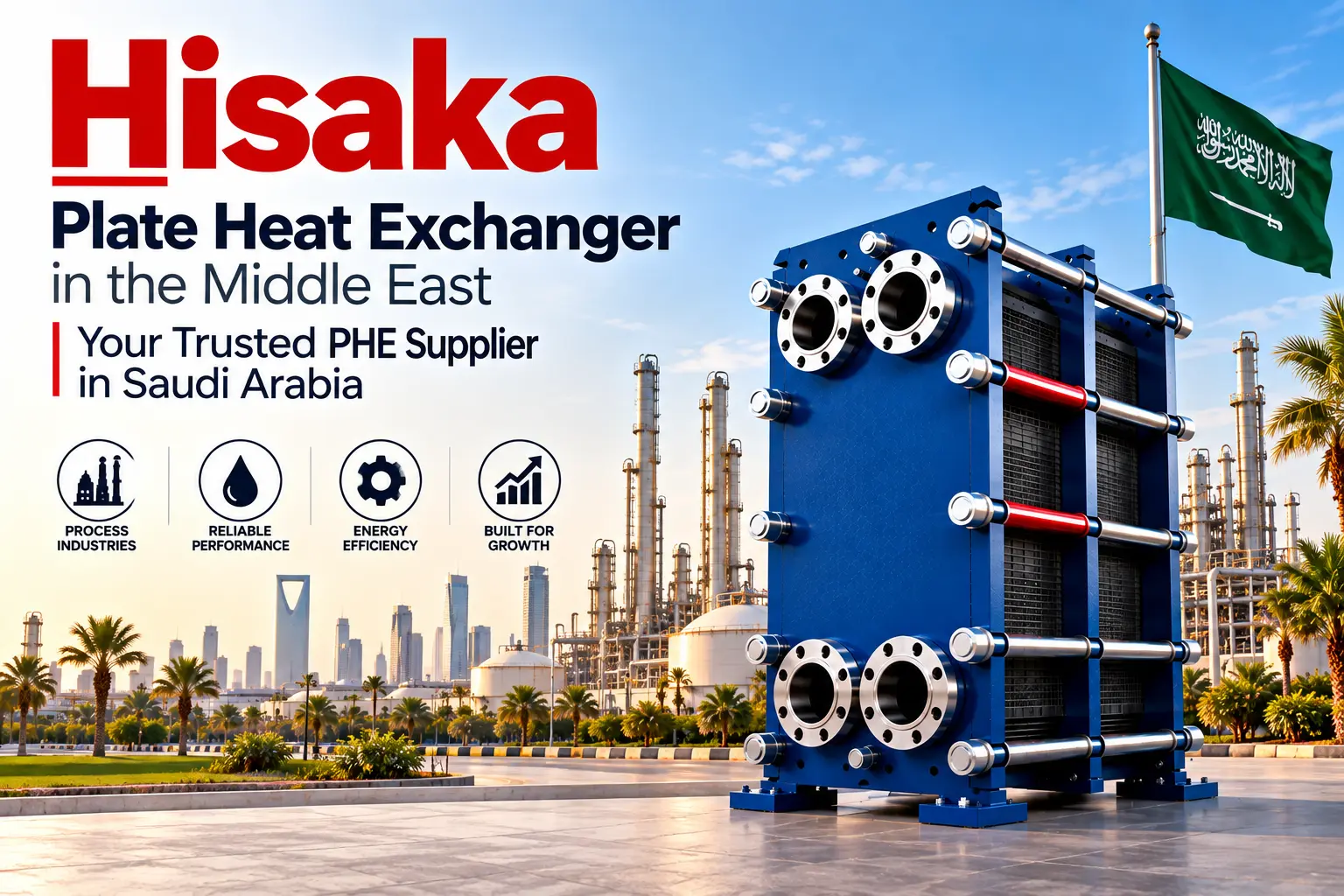
Across the Middle East, plate heat exchangers (PHEs) sit at the heart of almost every heavy-duty thermal process. From offshore oil and gas platforms in the Arabian Gulf to giant seawater desalination plants along the Red Sea coast, from district cooling stations keeping cities comfortable to food and beverage factories serving a growing population, reliable heat transfer equipment is not a luxury — it is a hard operational requirement. Among the global brands that engineers in the region trust, the Hisaka plate heat exchanger has earned a strong reputation for compact design, high thermal efficiency, and rugged performance in demanding conditions.
If you operate, maintain, or specify Hisaka units — or any other brand of gasketed plate heat exchanger — the single biggest challenge you face is keeping them running at peak efficiency without paying premium OEM prices or waiting weeks for imported spares. That is exactly where SRJ Heatt Exchangers steps in. As a specialist manufacturer and PHE supplier in Saudi Arabia and the wider Middle East, SRJ supplies precision-engineered plate heat exchanger plates and gaskets that are fully compatible with Hisaka models, along with complete PHE units, servicing, and after-sales support tailored to the region.
This guide is written for plant engineers, procurement managers, maintenance teams, EPC contractors, and facility operators across Saudi Arabia, the UAE, Qatar, Oman, Kuwait, and Bahrain. It explains what makes Hisaka plate heat exchangers so widely used in the Middle East, the industries and applications they serve, how to source genuine-quality compatible spare parts, and why partnering with the right PHE supplier in Saudi Arabia can dramatically cut your maintenance cost and downtime. By the end, you will know exactly how to keep your Hisaka and other PHE fleets performing — and who to call when you need parts fast.
What Is a Hisaka Plate Heat Exchanger?
A plate heat exchanger is a compact thermal device that transfers heat between two fluids using a stack of thin, corrugated metal plates instead of the bulky tube bundles found in traditional shell-and-tube exchangers. The plates are pressed with a herringbone or chevron pattern that creates turbulence, forcing the two fluids — a hot side and a cold side — to flow in thin channels on alternating sides of each plate. This turbulence, combined with a very large surface area packed into a small footprint, produces heat transfer coefficients several times higher than shell-and-tube equipment of comparable duty.
Hisaka Works Ltd., a Japanese manufacturer with decades of thermal engineering heritage, is one of the recognised global names in gasketed plate heat exchanger technology. Hisaka PHEs are known for tight manufacturing tolerances, optimised plate geometries, and elastomer gaskets engineered for long service life. In the Middle East, these qualities matter enormously: ambient temperatures are high, cooling water is often aggressive seawater or brackish water, and process fluids in oil, gas, and petrochemical plants can be corrosive. A well-built PHE that resists fouling and corrosion while maintaining thermal performance directly protects a plant’s uptime and profitability.
Key components of a gasketed plate heat exchanger
- Plates — the stainless steel or titanium plate pack that carries out the actual heat transfer.
- Gaskets — the rubber (elastomer) seals that direct fluid flow and prevent leakage or intermixing between the hot and cold streams.
- Frame and bars — the thick end plates and horizontal carrying/guide bars that hold the plate pack under compression.
- Tightening bolts — the threaded rods and nuts that compress the plate pack to the correct clamping dimension.
- Nozzles / connections — the ports where hot and cold fluids enter and leave the unit.
Of all these parts, the plates and gaskets are the wear items — the components most likely to degrade, corrode, or need periodic replacement. This is critical to understand for maintenance planning: you rarely need to replace an entire Hisaka plate heat exchanger. In the vast majority of cases, restoring full performance simply means re-gasketing the unit or replacing worn plates. This is precisely why a dependable supplier of Hisaka-compatible plates and gaskets is worth far more to your operation than a one-time equipment vendor.
Hisaka Plate Heat Exchanger Models Commonly Found in the Middle East
Hisaka manufactures a broad range of plate heat exchanger series, each optimised for different flow rates, pressures, temperatures, and duties. Understanding which series you have is the first step to sourcing the correct compatible plates and gaskets. Below is an overview of the Hisaka model families most frequently encountered on Middle East sites.
| Hisaka Series | Typical Duty / Character | Common Middle East Applications |
| RX Series | General-purpose, high-efficiency gasketed PHE range | HVAC, district cooling, general process cooling |
| SX Series | Compact, high heat-recovery designs | Food & beverage, chemical, light industrial |
| UX Series | Robust industrial duty, higher throughput | Oil & gas, petrochemical, power generation |
| LX Series | Larger-capacity plates for high flow rates | Desalination, seawater cooling, refineries |
| EX Series | High-performance heat transfer geometries | Energy recovery, process optimisation |
Note: model designations, plate sizes, and available materials evolve over time, and individual units may be configured with different plate counts, port sizes, and gasket materials. If you are unsure which Hisaka series or plate model you have, the fastest way to get the right parts is to send the nameplate details — model number, serial number, plate count, and connection sizes — to your PHE supplier. SRJ’s technical team can identify the exact compatible plate and gasket specification from these details and, where needed, from a physical sample plate or gasket.
How to read your Hisaka nameplate
Every plate heat exchanger carries a nameplate, usually mounted on the fixed frame plate. For accurate cross-referencing to compatible replacement parts, capture the following information:
- Manufacturer and model / type designation (e.g., the Hisaka series and plate model).
- Serial or unit number — useful for tracing the original build specification.
- Number of plates and the pass configuration.
- Design pressure and design temperature (PS / TS).
- Plate material (e.g., AISI 316 stainless steel or titanium) and gasket material.
- Connection / nozzle sizes and the clamping (tightening) dimension range, often shown as A-min and A-max.
With these details, a competent supplier can supply drop-in compatible plates and gaskets that match the original plate geometry, thickness, material, and pressing pattern — restoring the unit to its rated thermal performance without any need to modify the frame or connections.
Why Hisaka Plate Heat Exchangers Are So Widely Used in the Middle East
The Middle East presents one of the most demanding operating environments on earth for thermal equipment. High ambient temperatures, abundant use of seawater as a cooling medium, aggressive process chemistries, and around-the-clock production schedules place extreme stress on heat exchangers. Hisaka plate heat exchangers have become a common sight across the region for several practical reasons.
1. High thermal efficiency in a compact footprint
Space and weight are always at a premium — whether on an offshore platform, inside a packed refinery, or in a rooftop district cooling plant. Hisaka PHEs deliver large heat-transfer duties in a fraction of the space and weight of shell-and-tube exchangers, which is a decisive advantage where real estate and structural loading are limited.
2. Corrosion resistance for seawater and brine service
Much of the region’s cooling relies on seawater or brackish water. Hisaka units can be specified with titanium or high-grade stainless steel plates that resist chloride-induced corrosion, making them well suited to desalination and coastal power and process plants where cooling water is inherently aggressive.
3. Easy maintenance and serviceability
Because the plate pack can be opened, inspected, cleaned, re-gasketed, and reassembled on site, gasketed PHEs offer a maintenance model that suits the region’s uptime-driven industries. Plates can be added or removed to change capacity, and worn parts can be replaced without discarding the whole unit — provided compatible spares are readily available.
4. Proven reliability and brand trust
Engineers and procurement teams across the Gulf value equipment with a strong track record. Hisaka’s reputation for build quality and consistent performance has made it a specified brand in many plants, which in turn creates a large installed base — and a steady, ongoing demand for high-quality replacement plates and gaskets across the Middle East.
Middle East Applications of Hisaka & Other Plate Heat Exchangers
Plate heat exchangers touch nearly every major industry in the region. Understanding the specific demands of each application helps you specify the right plate material, gasket elastomer, and maintenance schedule. Here are the core sectors where Hisaka and compatible PHEs are deployed across Saudi Arabia and the GCC.
Oil & gas and petrochemicals
The backbone of the regional economy, the oil, gas, and petrochemical sector relies on plate heat exchangers for interstage cooling, condensate recovery, glycol heating and cooling, amine cooling, lube oil cooling, and countless process duties. These services often involve high pressures, elevated temperatures, and hydrocarbons or sour fluids, so plate material and gasket compatibility (for example, nitrile or fluoroelastomer gaskets rated for hydrocarbons) are critical selection factors. A supplier who understands these chemistries is essential.
Seawater desalination
The Middle East is home to some of the world’s largest desalination capacity. Both thermal (MED / MSF) and membrane (SWRO) desalination plants use plate heat exchangers extensively — for brine heating, heat recovery, and cooling duties. Seawater and brine service demands titanium plates or high-alloy stainless steel to survive chloride attack. Because desalination plants run continuously and any downtime affects municipal water supply, fast access to compatible plates and gaskets is a matter of operational necessity.
District cooling and HVAC
As cities across the Gulf expand, district cooling has become the standard for efficient, centralised air conditioning of large developments, malls, airports, and mixed-use districts. Plate heat exchangers separate the primary chilled-water loop from building secondary loops, enabling clean hydraulic separation and precise temperature control. These units cycle continuously through the long, hot cooling season, so gasket durability and plate cleanliness directly affect energy efficiency and comfort.
Power generation
Conventional, cogeneration, and combined-cycle power plants use PHEs for auxiliary cooling, closed-loop cooling water systems, lube oil cooling, and generator cooling. Reliability is paramount because heat-exchanger failure can force a unit derating or trip. Robust plate materials and disciplined re-gasketing schedules keep these critical systems dependable.
Food, beverage, and dairy
A growing population and expanding domestic manufacturing have driven strong demand for food-grade plate heat exchangers used in pasteurisation, chilling, and heat recovery for milk, juices, edible oils, and beverages. Hygienic design and food-safe gasket materials (such as EPDM approved for food contact) are the priorities here, along with plates that resist the mild acids and cleaning chemicals used in CIP (clean-in-place) cycles.
Chemical and pharmaceutical processing
Chemical and pharma plants use PHEs for precise temperature control of reactive and sometimes corrosive fluids. Correct plate alloy selection and chemically compatible gaskets are non-negotiable, and documentation and traceability of replacement parts often matter for quality compliance.
Marine and offshore
Ships, FPSOs, and offshore facilities operating in Gulf waters use compact plate heat exchangers for engine jacket cooling, central cooling, and fresh-water generation. Titanium plates are common for seawater duty, and the compact, low-weight design of gasketed PHEs is ideal for space- and weight-constrained vessels and platforms.
Whatever your sector, the common thread is clear: the plate heat exchanger itself may run for decades, but its plates and gaskets are consumables that must be maintained and periodically replaced with the correct compatible parts. This is the ongoing need that a specialist regional PHE supplier is built to serve.
PHE Supplier in Saudi Arabia: Market Overview & Why It Matters
Saudi Arabia is the largest industrial economy in the Middle East and one of the most heat-transfer-intensive markets in the world. The Kingdom’s oil and gas backbone, its enormous desalination programme, a fast-growing petrochemical and downstream sector, and the wave of construction and district cooling driven by national development goals all translate into a huge and growing installed base of plate heat exchangers — and an equally large need for spares, service, and new units.
Saudi Vision 2030 and industrial expansion
Saudi Arabia’s Vision 2030 economic diversification programme has accelerated investment in manufacturing, downstream petrochemicals, water infrastructure, tourism, and giga-projects. Each of these depends on thermal management. New desalination capacity, new industrial cities, expanded downstream complexes, and large real-estate developments with district cooling all add plate heat exchangers to the national fleet. For plant operators and contractors, this means both new-unit demand and a rising volume of maintenance and replacement-parts requirements over the equipment lifecycle.
The challenge: sourcing quality PHE parts locally and quickly
Despite the scale of demand, many operators in Saudi Arabia still struggle with three recurring pain points when it comes to plate heat exchanger spares:
- Cost and lead time — genuine OEM plates and gaskets are expensive and can carry long lead times when imported from distant factories.
- Downtime risk — a single failed or leaking PHE can halt a critical process, and waiting weeks for imported parts is not an option in continuous-process plants.
- Technical matching — not every supplier can correctly cross-reference and match plate geometry, material, and gasket specification to legacy or brand-specific units such as Hisaka.
A capable PHE supplier in Saudi Arabia solves all three: competitively priced, precision-manufactured compatible parts; short and predictable delivery to Gulf sites; and the engineering know-how to identify and match the correct specification for Hisaka and other brands. That combination is exactly what SRJ Heatt Exchangers brings to the region.
SRJ Heatt Exchangers: Your Hisaka-Compatible PHE Parts & Supply Partner
SRJ Heatt Exchangers is a specialist manufacturer of plate heat exchangers and PHE spare parts, supplying customers across India and the Middle East. SRJ focuses on what plant operators actually need day to day: high-quality, precisely matched replacement plates and gaskets that are compatible with all major PHE brands — including Hisaka — plus complete PHE units, re-gasketing, and technical support.
For customers running Hisaka plate heat exchangers in the Middle East, SRJ offers a practical alternative to expensive, slow OEM sourcing. Every plate is pressed to match the original plate geometry, pitch, and pressing depth; every gasket is moulded to the correct profile and supplied in the right elastomer for your fluid and temperature. The result is a genuine drop-in replacement that restores rated thermal performance — at a significantly lower total cost of ownership.
What SRJ supplies for Hisaka and other PHEs
- Compatible replacement plates — precision-pressed in stainless steel (AISI 304, 316, 316L), titanium, and other alloys, matched to your original plate model.
- Compatible gaskets — clip-on and glued PHE gaskets and replacement parts moulded in NBR, EPDM, and fluoroelastomer (FKM/Viton-type) to suit your process fluid and temperature.
- Complete PHE units — newly manufactured gasketed plate heat exchangers engineered to your duty specification.
- Re-gasketing & servicing — on-site or workshop re-gasketing, plate cleaning, inspection, and pack refurbishment.
- Technical identification — nameplate and sample-based cross-referencing to identify the exact compatible specification for your unit.
Why customers across the Middle East choose SRJ
- Cost savings — compatible parts at a fraction of OEM pricing, reducing your maintenance budget without compromising quality.
- Fast turnaround — manufacturing capability geared to short lead times, with export experience serving Saudi Arabia and the wider GCC.
- Precision matching — plates and gaskets built to match original geometry and materials, so performance and clamping dimensions are preserved.
- Application expertise — material and profile selection guided by your actual process conditions, not guesswork.
- Direct support — responsive quotation and technical assistance for engineers and procurement teams across the region.
Hisaka Replacement Plates & Gaskets: What You Need to Know
The single most common maintenance requirement for any gasketed plate heat exchanger is replacement of the plates and gaskets. Understanding when and why these parts wear out — and how compatible replacements work — helps you plan maintenance intelligently and avoid unplanned failures.
When do PHE gaskets need replacing?
Gaskets are elastomer seals, and like all rubber components they age. Heat, compression set, chemical exposure, and repeated thermal cycling gradually harden and shrink them, eventually causing leaks between plates or external drips. As a general rule, gaskets should be inspected at every planned opening of the unit and replaced whenever they show hardening, cracking, permanent deformation, or loss of elasticity. In high-temperature or chemically aggressive service, gasket life is shorter and re-gasketing is a routine, scheduled activity rather than a reactive repair.
When do plates need replacing?
Plates are far more durable than gaskets but are not immortal. Over time they can suffer from corrosion (especially chloride pitting in seawater service), erosion, fouling that resists cleaning, mechanical damage, or stress cracking around the ports. Signs that plates need replacement include visible pinholes or cracks, cross-contamination between the two fluids, persistent performance loss after cleaning, and thinning detected during inspection. Replacing damaged plates with correctly matched compatible plates restores both the pressure integrity and the thermal duty of the unit.
How compatible (non-OEM) plates and gaskets work
A compatible plate or gasket is manufactured to match the exact geometry and material of the original part so that it functions as a direct drop-in replacement. For plates, this means matching the plate length and width, port positions and sizes, corrugation (chevron) angle and pitch, pressing depth, and material grade. For gaskets, it means matching the groove profile, cross-section, attachment method (clip-on or glued), and elastomer type. When these parameters are correctly reproduced, compatible parts deliver the same performance as OEM parts while typically costing considerably less and often being available faster. SRJ specialises in exactly this precision matching for Hisaka and other leading PHE brands.
Mixing OEM and compatible parts
It is perfectly acceptable — and common practice — to service an OEM Hisaka unit with high-quality compatible plates and gaskets. Because compatible parts are engineered to the same dimensional and material standards, they integrate seamlessly with existing OEM plates in the pack. What matters is not the brand printed on the part but whether it correctly reproduces the original specification. This is why choosing a supplier with genuine engineering capability, rather than a generic reseller, is so important.
Plate & Gasket Materials: Choosing the Right Specification
Selecting the correct plate metal and gasket elastomer is the most important technical decision in PHE maintenance. The wrong material fails prematurely; the right one delivers years of trouble-free service.
Plate materials
| Plate Material | Best For | Notes |
| AISI 304 SS | Mild, non-aggressive water and general duty | Economical; not for high chloride service |
| AISI 316 / 316L SS | General process, moderate chlorides, wide use | The most common all-round PHE plate material |
| Titanium | Seawater, brine, high-chloride & desalination | Excellent chloride corrosion resistance |
| SMO 254 / high alloy | Very aggressive brine and chemical service | Used where 316 and Ti need supplementing |
| Nickel alloys | Special corrosive / high-temperature chemistry | Application-specific selection |
Gasket materials
| Gasket Elastomer | Best For | Typical Limits / Notes |
| NBR (Nitrile) | Oils, water, general hydrocarbons | Good for oil & gas water/oil duties |
| EPDM | Hot water, steam, food & beverage | Not compatible with mineral oils |
| FKM (Viton-type) | High temperature, aggressive chemicals, oils | Premium elastomer for tough service |
| HNBR | Higher-temperature hydrocarbon service | Upgraded nitrile performance |
Because material selection depends on your exact fluids, temperatures, and pressures, it is always best to confirm the specification with a supplier who understands your application. Supplying an incorrect gasket elastomer — for example, EPDM in an oil service — will cause rapid gasket failure. SRJ’s technical team helps match the right plate alloy and gasket compound to each duty, drawing on experience across the region’s oil and gas, desalination, HVAC, and food processing sectors.
Serving Saudi Arabia and the Entire GCC
While Saudi Arabia is a core market, SRJ supplies Hisaka-compatible plates and gaskets, complete PHE units, and servicing across the whole Gulf region.
Saudi Arabia — the largest market in the region, driven by oil and gas, petrochemicals, the world’s biggest desalination footprint, power generation, and rapidly expanding district cooling and industrial development under Vision 2030. Demand spans everything from titanium plates for seawater duty to food-grade gaskets for the growing manufacturing base.
United Arab Emirates (UAE) — a hub for oil and gas, aluminium and heavy industry, large-scale district cooling across Dubai and Abu Dhabi, and extensive desalination. The UAE’s dense concentration of high-rise developments and mega-projects sustains strong ongoing demand for PHE maintenance parts.
Qatar — home to major LNG and gas processing infrastructure, Qatar operates a significant fleet of heat exchangers in demanding hydrocarbon service, alongside desalination and district cooling for its urban centres.
Oman — with growing oil and gas, refining, and industrial activity, plus coastal desalination and power plants, Oman represents a steady market for both replacement parts and complete PHE units.
Kuwait — a major oil producer and refiner, Kuwait relies heavily on plate heat exchangers in its downstream and utility systems, as well as in water production, creating consistent demand for spares and servicing.
Bahrain — Bahrain’s refining, aluminium, and industrial sectors, along with desalination and cooling infrastructure, round out a GCC-wide market in which reliable, quickly available PHE parts are always in demand.
How to Choose the Right PHE Supplier in the Middle East
Not all suppliers are equal. When your production depends on reliable heat transfer, the supplier you choose for plates, gaskets, and complete units directly affects your uptime, safety, and maintenance cost. Use the following checklist to evaluate any PHE supplier in Saudi Arabia or the wider Middle East:
- Can the supplier correctly identify and match your plate model and gasket profile — including brand-specific units like Hisaka — from nameplate details or a physical sample?
- Are plates pressed to reproduce the original geometry, pitch, and pressing depth, and are gaskets moulded to the exact groove profile and attachment method?
- Does the supplier offer the correct plate alloys (304, 316/316L, titanium, high alloys) and gasket elastomers (NBR, EPDM, FKM, HNBR) for your specific fluids and temperatures?
- Can they meet the lead times your operation requires, with reliable export logistics to Gulf sites?
- Is pricing genuinely competitive against OEM without cutting corners on material quality or dimensional accuracy?
- Do they provide technical support — application advice, material selection, and troubleshooting — rather than just taking orders?
- Can they also handle complete units, re-gasketing, and refurbishment, so you have a single partner for the full PHE lifecycle?
A supplier that answers “yes” across this checklist becomes a long-term partner rather than a transactional vendor. SRJ Heatt Exchangers is structured around exactly these capabilities.
PHE Maintenance & Servicing Best Practices
Even the best plate heat exchanger requires disciplined maintenance to deliver its full service life, especially in the harsh operating conditions of the Middle East.
Routine inspection and monitoring
Monitor pressure drop and outlet temperatures continuously. A rising pressure drop across the unit usually signals fouling, while a falling thermal performance indicates scaling or plate damage. Watch for any external leakage at the plate pack, which often means gaskets need attention. Track the clamping dimension against the specified range — over-tightening to stop a leak is a common mistake that damages plates and gaskets.
Cleaning: CIP and manual
Fouling is the enemy of PHE efficiency. Clean-in-place (CIP) circulation of appropriate cleaning chemicals removes many deposits without opening the unit, while heavier fouling or scaling may require opening the pack for manual cleaning. Always use cleaning agents compatible with your plate and gasket materials, and rinse thoroughly. In seawater and hard-water service, scale management is an ongoing priority.
Re-gasketing
Re-gasketing is the scheduled replacement of gaskets during a planned opening. It is far cheaper to re-gasket on a planned schedule than to react to a leak in the middle of production. Keep a set of compatible gaskets in stock for your critical units so that maintenance windows are never delayed by parts availability. SRJ can supply gasket sets matched to your exact plate model and recommend a sensible re-gasketing interval for your duty.
Plate inspection and replacement
Whenever the unit is open, inspect plates for pitting, cracks, deformation, and thinning. Dye-penetrant testing can reveal hairline cracks not visible to the eye. Replace any suspect plates with correctly matched compatible plates before reassembly. Reassemble in the correct plate order and orientation, fit new gaskets properly, and tighten evenly to the specified clamping dimension.
Spare parts strategy
For critical PHEs, holding a strategic stock of compatible plates and a full gasket set dramatically reduces downtime risk. Combined with a reliable regional supplier for rapid replenishment, this approach ensures that a gasket failure or damaged plate never becomes a prolonged production stoppage.
Total Cost of Ownership: Compatible Parts vs OEM
For procurement and maintenance managers, the economics are compelling. Genuine OEM plates and gaskets carry premium pricing and, when imported into the region, can involve long lead times and high logistics costs. High-quality compatible parts from a specialist manufacturer like SRJ deliver the same dimensional accuracy, material grades, and thermal performance at a substantially lower price — often with faster availability.
Consider the full lifecycle of a plate heat exchanger. Over its service life, a unit may be re-gasketed several times and have plates replaced at least once. Each of these events is an opportunity to reduce cost without sacrificing reliability. By standardising on a trusted compatible-parts supplier, operators across Saudi Arabia and the GCC routinely cut their PHE maintenance spend meaningfully while keeping — or even improving — reliability. The savings compound across a fleet of units and across years of operation.
Importantly, lower cost does not mean lower quality here. Compatible parts are only a saving if they are engineered correctly. The value lies in getting OEM-equivalent geometry and materials at a better price and lead time — which is precisely the SRJ proposition for Hisaka and other PHE brands in the Middle East.
Common Plate Heat Exchanger Problems & How to Solve Them
Reduced heat transfer performance
If your unit no longer reaches the required outlet temperatures, the usual cause is fouling or scaling on the plate surfaces. The first response is a thorough clean — CIP for light fouling, or opening the pack for manual cleaning of heavier deposits. If performance does not recover after cleaning, the plates may be corroded, deformed, or thinning, in which case correctly matched compatible plates restore the original duty.
External leakage from the plate pack
Drips from between the plates almost always indicate gasket problems. Before re-gasketing, check the clamping dimension — a pack that has relaxed below the specified tightening dimension can leak from under-compression. If tightening to the correct dimension does not stop the leak, a full re-gasket with correctly matched compatible gaskets is required. Never over-tighten beyond the minimum specified dimension to chase a leak.
Cross-contamination between fluids
If the two fluids are mixing, one or more plates almost certainly has a crack, pinhole, or corrosion breakthrough. The unit must be opened and each plate inspected (dye-penetrant testing helps find hairline cracks). Damaged plates must be replaced with correctly matched compatible plates. In seawater service, chloride pitting is the most common root cause — which is why titanium plates are specified for such duties.
Rising pressure drop
An increasing pressure drop at the same flow rate is a classic fouling indicator — the flow channels are narrowing with deposits, which also raises pumping energy costs. Cleaning usually restores the correct pressure drop. If fouling recurs rapidly, review upstream filtration, water treatment, and operating temperatures.
Gasket blow-out or repeated gasket failure
If gaskets fail quickly after replacement, the elastomer is likely wrong for the service — for example, EPDM used with oils. The solution is to switch to the correct elastomer (NBR, FKM, or HNBR as appropriate). A knowledgeable supplier prevents this problem at the specification stage.
Beyond Hisaka: Compatible Parts for All Major PHE Brands
Most Middle East sites operate a mixed fleet of PHE brands accumulated over years of expansion. A key advantage of working with a specialist manufacturer like SRJ is that a single supplier can provide compatible plates and gaskets across all of these brands.
SRJ manufactures compatible plates and gaskets matched to the major gasketed plate heat exchanger brands found throughout the region, including Hisaka, GEA / Kelvion, APV / SPX, Sondex / Danfoss, Tranter / SWEP, Funke / HRS, and more. Because the manufacturing approach is the same — matching the exact plate geometry, pressing depth, material, and gasket profile — a compatible part for any of these brands functions as a true drop-in replacement in the original frame.
For procurement teams, the benefit is significant. Instead of maintaining separate OEM relationships for each brand of PHE on site, you can source high-quality compatible plates and gaskets for your entire fleet from one regional partner — reducing administrative overhead, improving negotiating leverage, and shortening lead times.
Energy Efficiency & Sustainability in the Middle East Climate
In a region where cooling demand is enormous and energy costs and carbon targets are increasingly in focus, the efficiency of heat transfer equipment has a direct financial and environmental impact. Plate heat exchangers are inherently among the most efficient heat-transfer devices available, and keeping them in top condition is one of the most cost-effective sustainability measures a plant can take.
A fouled or degraded plate heat exchanger forces the rest of the system to work harder: pumps consume more energy pushing fluid through narrowed channels, chillers and boilers run longer to compensate for lost heat transfer, and overall process efficiency falls. By maintaining clean plates, correctly compressed packs, and healthy gaskets, operators recover this lost efficiency — reducing both energy bills and emissions.
Replacing worn or corroded plates with correctly matched compatible plates also restores the original thermal performance, meaning the exchanger once again achieves its design duty with the minimum energy input. For Middle East operators facing long, hot cooling seasons and rising energy scrutiny, a disciplined PHE maintenance programme — supported by a reliable regional parts supplier — is a straightforward way to improve efficiency, cut operating cost, and support broader sustainability goals such as those embedded in national development plans.
Glossary of Key Plate Heat Exchanger Terms
- Plate Heat Exchanger (PHE) — a compact heat exchanger using a stack of thin corrugated metal plates to transfer heat between two fluids.
- Plate — the individual pressed metal plate that provides the heat-transfer surface; a wear item along with gaskets.
- Gasket — the elastomer (rubber) seal that directs flow and prevents leakage between plates.
- Plate pack — the complete stack of plates and gaskets compressed together within the frame.
- Clamping / tightening dimension — the compressed length of the plate pack between the frame plates, specified between A-min and A-max.
- Chevron / herringbone pattern — the V-shaped corrugation pressed into each plate that creates turbulence and mechanical strength.
- Fouling — the buildup of deposits, scale, or biological matter on plate surfaces that reduces heat transfer.
- CIP — Clean-In-Place: circulating cleaning chemicals through the unit without opening it.
- Re-gasketing — the scheduled replacement of all gaskets during a planned maintenance opening.
- OEM — Original Equipment Manufacturer, the company that built the original unit.
- Compatible part — a part manufactured to match the original specification exactly, functioning as a direct drop-in replacement.
Frequently Asked Questions (FAQ)
- Do you supply parts for Hisaka plate heat exchangers in the Middle East?
A. Yes. SRJ manufactures and supplies plates and gaskets that are fully compatible with Hisaka plate heat exchangers, along with complete PHE units and servicing, for customers across Saudi Arabia, the UAE, Qatar, Oman, Kuwait, and Bahrain. Parts are engineered as direct drop-in replacements matched to your original plate geometry and materials. - Are your compatible plates and gaskets as good as OEM parts?
A. When compatible parts correctly reproduce the original geometry, pressing depth, material grade, and gasket profile, they deliver the same thermal performance and pressure integrity as OEM parts. SRJ specialises in this precision matching, so you get OEM-equivalent performance at a lower price and often a shorter lead time. - Can I use compatible parts in an existing OEM Hisaka unit?
A. Yes. Because compatible plates and gaskets are made to the same dimensional standards, they integrate seamlessly with existing OEM plates in the pack. It is common and accepted practice to service branded units with high-quality compatible parts. - How do I identify which Hisaka model and plate I have?
A. Send us the nameplate details — model/type, serial number, plate count, design pressure and temperature, connection sizes, and clamping dimension — and, where possible, a photo or a physical sample plate or gasket. Our technical team will cross-reference the exact compatible specification for you. - Which plate material should I choose for seawater service?
A. For seawater, brine, and high-chloride duties such as desalination, titanium plates are the standard choice for their outstanding chloride corrosion resistance. For milder duties, 316/316L stainless steel is usually sufficient. We help you select based on your actual water chemistry and temperature. - What gasket material do I need for oil and gas service?
A. Hydrocarbon and oil duties typically require nitrile (NBR) or, for higher temperatures and more aggressive chemistry, fluoroelastomer (FKM/Viton-type) gaskets. EPDM must not be used with mineral oils. We match the elastomer to your specific fluid and temperature. - How often should PHE gaskets be replaced?
A. Gaskets should be inspected at every planned opening and replaced whenever they show hardening, cracking, permanent set, or loss of elasticity. In high-temperature or aggressive service, scheduled re-gasketing at defined intervals is best practice rather than waiting for a leak. - Do you supply complete new plate heat exchangers as well as parts?
A. Yes. In addition to compatible plates and gaskets, SRJ manufactures complete gasketed plate heat exchangers engineered to your duty specification, and provides re-gasketing, plate cleaning, inspection, and refurbishment services. - Can you deliver quickly to Saudi Arabia and other GCC countries?
A. SRJ’s manufacturing is geared to short lead times, and we have export experience serving Saudi Arabia and the wider GCC. For critical units, we also recommend holding a strategic stock of gaskets and key plates to eliminate downtime risk. - How much can I save by choosing compatible parts over OEM?
A. Savings vary by model and material, but high-quality compatible plates and gaskets typically cost significantly less than OEM parts while delivering equivalent performance. Across multiple re-gasketing cycles and a fleet of units, these savings compound substantially over the equipment lifecycle. - What information do you need to give me a quotation?
A. The fastest route to an accurate quote is your unit’s nameplate data (brand/model, plate count, pressures, temperatures, connection sizes), the fluids on each side, and the quantity of plates or gasket sets required. A photo of the nameplate and a sample part speed things up further. - Do you provide technical support for material and application selection?
A. Yes. Our team advises on plate alloy and gasket elastomer selection, troubleshooting fouling and leakage, re-gasketing intervals, and maintenance best practice — drawing on experience across the region’s oil and gas, desalination, HVAC, power, and food processing sectors.
Conclusion: Keep Your Hisaka & PHE Fleet Running With the Right Partner
Plate heat exchangers are indispensable to the Middle East’s most important industries — oil and gas, desalination, power, district cooling, and food processing. Hisaka plate heat exchangers, in particular, enjoy a strong installed base across the region thanks to their efficiency, durability, and serviceability. But the long-term performance of any PHE depends on one thing: keeping it supplied with the correct plates and gaskets, maintained on a disciplined schedule, and backed by a supplier who understands both the equipment and the region.
SRJ Heatt Exchangers delivers exactly that. As a specialist manufacturer and PHE supplier in Saudi Arabia and across the GCC, SRJ provides precision-engineered, Hisaka-compatible plates and gaskets, complete PHE units, and full servicing — at a lower total cost of ownership and with the responsiveness that continuous-process plants demand.
Ready to source Hisaka-compatible PHE plates & gaskets or a complete unit? Contact SRJ Heatt Exchangers today with your unit’s nameplate details for a fast, competitive quotation and expert technical support across Saudi Arabia and the Middle East.
Related Resources
- Hisaka Replacement Plates & Gaskets
- Plate Heat Exchangers for Middle East Industries – Applications & Price Guide
- PHE Replacement Parts (All Brands)
- Gasketed Plate Heat Exchangers
- Plate Heat Exchanger Maintenance Steps
Frequently Asked Questions About the Hisaka Plate Heat Exchanger
Is SRJ a genuine PHE Supplier in Saudi Arabia for Hisaka units?
Yes. As a specialist manufacturer and PHE Supplier in Saudi Arabia, SRJ Heatt Exchangers supplies precision-engineered plates and gaskets that are fully compatible with your Hisaka Plate Heat Exchanger, along with complete PHE units, servicing, and after-sales support across the Middle East.
Can SRJ supply compatible plates and gaskets for any Hisaka Plate Heat Exchanger model?
SRJ manufactures compatible plates and gaskets for the common Hisaka Plate Heat Exchanger series used across Saudi Arabia, the UAE, Qatar, Oman, Kuwait, and Bahrain. Share your Hisaka nameplate model and our team will match the exact plate pattern and gasket material.
How much can I save versus imported OEM spares?
Sourcing your Hisaka Plate Heat Exchanger spares through SRJ typically cuts spare-parts cost significantly compared with imported OEM parts, while reducing lead times and plant downtime.
Where can I learn more?
You can review the original manufacturer at Hisaka Works Ltd. and read the engineering background on plate heat exchanger technology before choosing your PHE Supplier in Saudi Arabia.